
24/7 Service for Water Damage Emergency
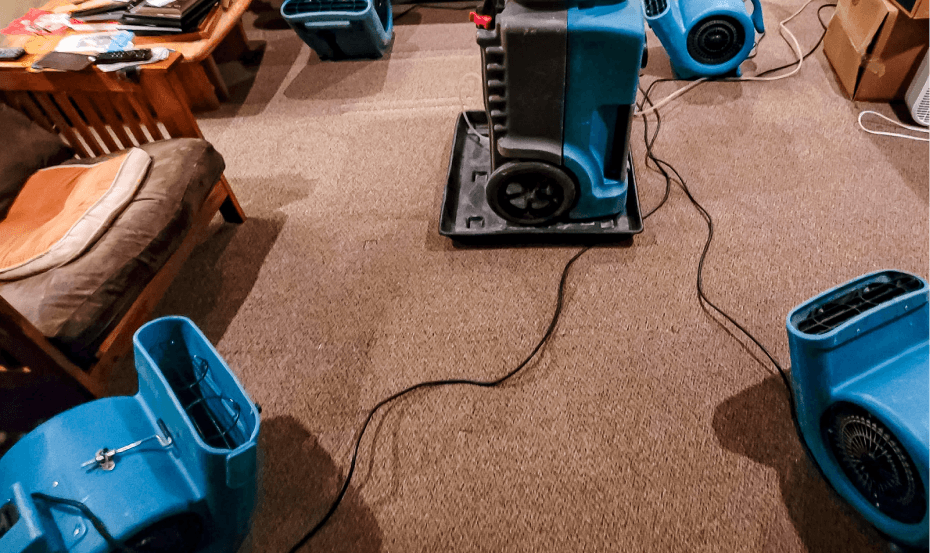
Renting an air mover is generally better than a household fan for drying water-damaged areas because it is designed to direct concentrated airflow across wet surfaces. While a regular fan can improve comfort and circulate room air, an air mover is built for more demanding drying applications, including wet floors, carpets, and wall surfaces.
At Restoration Express, our restoration equipment rental options help customers access equipment without purchasing it outright. Whether you need drying equipment rental for a renovation or an air mover rental for a water-damaged room, choosing the right equipment can make drying more effective.
A household fan typically moves air through a broad area. Its main purpose is to improve ventilation and comfort. On the other hand, an air mover is designed to deliver stronger, more focused airflow that can be directed along floors, walls, and other surfaces.
This airflow helps moisture evaporate from exposed materials so that it can be removed from the surrounding air.
| Feature | Household Fan | Air Mover |
|---|---|---|
| Primary purpose | General air circulation | Surface drying |
| Airflow direction | Broad, often adjustable | Concentrated and directional |
| Placement | Usually upright | Often supports floor-level positioning |
| Typical application | Cooling and ventilation | Wet carpets, floors, and building materials |
| Equipment design | General household use | More demanding drying applications |
Not every air mover has the same airflow capacity or positioning options, so equipment specifications still matter.
Water can remain trapped in carpet fibres, along baseboards, and on other surfaces even after visible puddles have been removed. Positioning an air mover to push air across a damp surface helps replace the humid air immediately above it.
For example, directing airflow along a wet floor can support evaporation more effectively than placing a household fan across the room.
However, airflow alone cannot guarantee that moisture trapped beneath flooring or inside walls has been removed.
Often, yes. Air movers encourage moisture to evaporate, but that moisture enters the surrounding air. Without adequate dehumidification or ventilation, indoor humidity can rise and slow further drying.
An appropriately sized dehumidifier rental removes moisture from the air, allowing drying to continue more effectively.
For larger or particularly damp spaces, combining air movers with dehumidifiers may be more useful than relying on fans alone. Customers exploring drying equipment rental should consider both airflow and moisture removal when choosing equipment.
Placement depends on the affected materials and the equipment's design.
A few general considerations include:
If water may have reached electrical outlets or wiring, do not operate equipment until the area has been assessed for electrical safety.
An air mover rental can be useful when a household fan cannot provide the concentrated airflow needed for a drying project.
Rental equipment may be particularly practical for temporary applications where purchasing commercial equipment would be unnecessary.
At Restoration Express, we offer equipment rental options for customers who need access to professional drying tools.
Our restoration equipment rental selection allows you to compare equipment for your project without committing to a permanent purchase.
Choosing the right equipment can help you manage a drying project more efficiently.
Whether you need an air mover, a dehumidifier, or a combination of equipment, Restoration Express can help you explore rental options.
Visit our Toronto equipment rental page to learn more about available equipment and rental arrangements.
Rent our professional-grade drying equipment today and get the water removed and the affected areas dried out quickly and efficiently. Get in touch to learn more and to rent the equipment you need.


